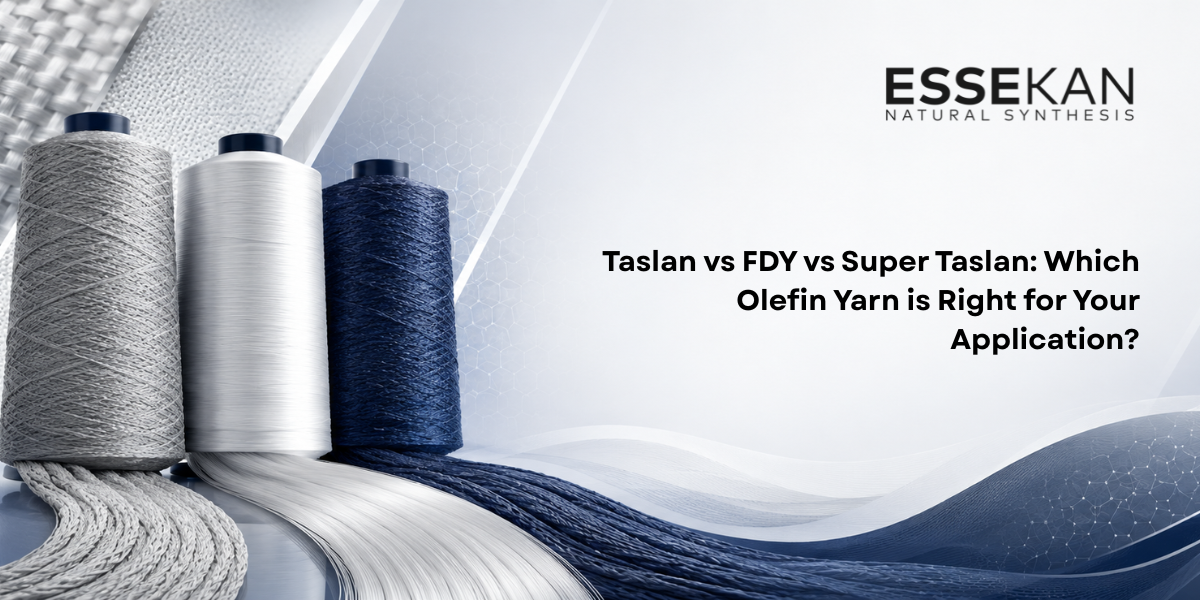
Taslan vs FDY vs Super Taslan: Which Olefin Yarn is Right for Your Application?
Choosing the right yarn has become much more than a technical choice because it determines the quality of your finished goods’ performance and functionality in real-life environments. Whether the choice is amongst Taslan, FDY, or Super Taslan, you have several factors influencing the purchase.
All three materials are different olefin filament yarn types, extensively used in polypropylene manufacturing. However, the processing method makes a whole lot of difference in the final product despite the identical material composition.
This is what helps companies reach the level of optimization of their products’ performance.
What Are Olefin Filament Yarn Types and Why Do They Matter?
Choosing the right yarn has become much more than a technical choice because it determines the quality of your finished goods’ performance and functionality in real-life environments. Whether the choice is amongst Taslan, FDY, or Super Taslan, you have several factors influencing the purchase.
All three materials are different olefin filament yarn types, extensively used in polypropylene manufacturing. However, the processing method makes a whole lot of difference in the final product despite the identical material composition.
This is what helps companies reach the level of optimization of their products’ performance.
What Is FDY Yarn? Properties, Benefits, and Industrial Applications
FDY (Fully Drawn Yarn) is designed to be strong, stable, and accurate. While in production, the yarn is elongated in order to achieve proper orientation of its molecules, thus maximizing crystallinity and decreasing elasticity. The resulting fiber is strong, uniform, and dimensionally stable.
It is exactly this high orientation of the fiber that makes FDY so effective. It retains its shape under pressure and has minimal shrinkage – all characteristics that are extremely beneficial in certain cases.
FDY differs from textured yarns due to the fact that it has a smooth and even surface. FDY is not bulk or soft; however, it guarantees exceptional structural quality.
This feature becomes significant when comparing air-textured vs. FDY yarn. In most cases, you can expect FDY to be used in technical, industrial, hygiene, and medical textiles.
What Is Taslan Yarn? Key Features and Taslan Yarn Applications
The production process of Taslan yarn optimises air texturization technology, which uses compressed air to form loops and tangles within the filament. As such, a flat yarn is transformed into a bulkier, softer yarn resembling spun yarn.
It is this structural distinction that distinguishes Taslan yarn from FDY yarn.
Taslan yarn is about usability, texture, and coverage, rather than being the strongest yarn available. Its increased bulkiness leads to better opacity and provides a natural and matte finish to the fabric. It also improves its grip, making it ideal for handling fabrics that require higher friction.
Super Taslan has the following properties:
- Increased evenness of the bulk
- Enhanced abrasion resistance
- Improved performance uniformity
Although the conventional Taslan primarily emphasizes texture, Super Taslan makes the texture even and more resistant to daily wear and tear.
If we consider the entire picture of Taslan yarn vs FDY yarn vs Super Taslan yarn, we find that the FDY works best in cases where performance and appearance matter equally. Super Taslan yarn is used for producing automotive textiles, high-end outdoor equipment, and technical fabrics requiring durability.
Air Textured vs FDY Yarn: Key Differences in Structure and Performance
This manufacturing difference is the heart of this comparison.
While FDY yarn is created through drawing and orientation of the yarn, making the yarn extremely strong, straight, and well-aligned, the Taslan and Super Taslan yarns are created through air texturing of the yarn; therefore, loops and bulkiness are among the characteristics of such yarn.
The manufacturing difference is critical for the essence of the comparison of air-textured and FDY yarns.
Drawing provides a precise and strong yarn, whereas air-texturing yields a soft and flexible yarn.
When it comes to the Taslan vs FDY vs Super Taslan yarn comparison, this point must be considered.
Taslan vs FDY vs Super Taslan Yarn: Key Differences Explained
Rather than evaluating these yarns as superior or inferior, it is helpful to consider how they perform differently in practice.
FDY produces a cloth that is silky, sturdy, and structurally sound. It is best for situations where the fabric needs to retain its form and endure tension.
Taslan produces a fabric that is bulkier, more comfortable, and looks more organic. It makes for better usage and feel, which makes it a more appropriate choice for consumer products.
Super Taslan sits somewhere between the two. It increases resilience without sacrificing texture, providing a more balanced alternative for harsh conditions.
This hierarchical perspective is crucial in evaluating the relative merits of Taslan vs FDY vs Super Taslan yarn, as each yarn addresses a distinct issue.
How to Choose Amongst Taslan Yarn, FDY Yarn, and Super Taslan Yarn
Ultimately, your decision will depend on your application needs.
If durability and sustainability are among your top priorities, then FDY yarn would suit you perfectly. This yarn has great tensile strength and is often used in industrial applications.
However, if your application requires more softness and a bulkier fabric, then you should choose Taslan yarn. This kind of yarn is often used in materials that directly interact with customers.
Alternatively, if you need durability, flexibility, and aesthetics in your application, then Super Taslan yarn would be an ideal choice. This yarn possesses the advantages of air-texturizing while being more durable.
This is precisely why it is necessary to know about the different types of olefin filament yarns.
Selection of Suitable Olefin Yarn For You from Essekan
At Essekan, not only does the emphasis lie on the manufacture of yarn, but also on making the right choices about yarns and the quality control thereof.
It can be the strength of FDY or the flexibility of the polypropylene taslan yarn, or even the technological superiority of Super Taslan. In comparison between Taslan, FDY, and Super Taslan yarn, it is important to mention that Essekan aims to be the best in providing you with your yarn needs instantly.
Conclusion
Information about materials is considered a competitive edge in the modern textile industry. It is important to take advantage of differences in properties for all varieties of yarns. Information about materials will have an effect on operational results.
The analysis of differences between Taslan, FDY, and Super Taslan yarn proves that all these varieties have unique methods of yarn manufacture.
It is necessary to take into account information about materials while choosing FDY, Taslan, and Super Taslan yarn. Ready to find the perfect yarn for your next project?
Contact Essekan today and let our experts guide you to the right solution for your application.
Frequently Asked Questions
What is the main difference in Taslan, FDY, and Super Taslan yarn?
Taslan yarn FDY, vs Super Taslan yarn are distinct due to structural aspects, manufacturing process, and functionality. The FDY yarn is well-known because it is fully drawn, with its characteristic smooth surface and high strength and stability. With a characteristic air-textured appearance, Taslan yarn is notable for its bulky and soft appearance. While Taslan yarn’s structure is reinforced and improved with Super Taslan yarn. All three olefin filament yarn types differ from each other based on performance aspects.
Which is better: Taslan yarn vs FDY yarn?
When selecting between Taslan yarn and FDY yarn, the decision will be based on operational circumstances. FDY is preferred for its strength and stability, as well as special-purpose applications. On the other hand, Taslan yarn is preferred when seeking comfort and content. Comparing Taslan vs FDY vs Super Taslan yarn, the latter proves to be preferable when continuity and texture are essential.
What are the most common uses for Taslan yarn?
One of the main Taslan yarn application areas is outdoor fabric products such as bags, backpacks, and clothes, including upholstery and protective textiles. The bulkiness, softness, and flexibility of the yarn make it more preferable for those applications. Polypropylene Taslan yarn is usually used in order to increase moisture resistance and lightweight. The main benefit of using Taslan yarn is comfort and ease, which can be compared with FDY and Super Taslan.
Can polypropylene taslan yarn be used in industry?
Yes, definitely, Taslan yarn can be used in industrial applications because of the strength of the yarn, low water absorbance, and making it a kind of fire-resistant yarn and resistant to chemicals. Because of the consistent qualities of the yarn regardless of the weather conditions, Taslan yarn is good for performance and ease compared to other olefin filament yarns.
How does air-textured yarn differ from FDY yarn?
The major distinguishing elements between air-textured yarn and FDY yarn involve their manufacturing process and the final products. FDY yarn is created via drawing and orientation of fibers, making it strong and having a smooth surface with dimensional stability. In contrast, air-textured yarns like Taslan and Super Taslan use compressed air technology that provides loops for creating a soft and flexible material. This aspect forms the background for the comparison of Taslan vs FDY vs Super Taslan yarn because it defines the texture and appearance of the material along with its application fields.
For what purposes is Super Taslan used?
Super Taslan has multiple purposes, including automotive textiles, outdoor wear, technical textiles, and high-end upholstery. It combines the durability and quality of regular Taslan while maintaining its texture. Compared to Taslan vs FDY vs Super Taslan yarn types, this option has the most advanced feature set.