What Is Solution-Dyed Olefin Yarn? | Essekan Complete Guide
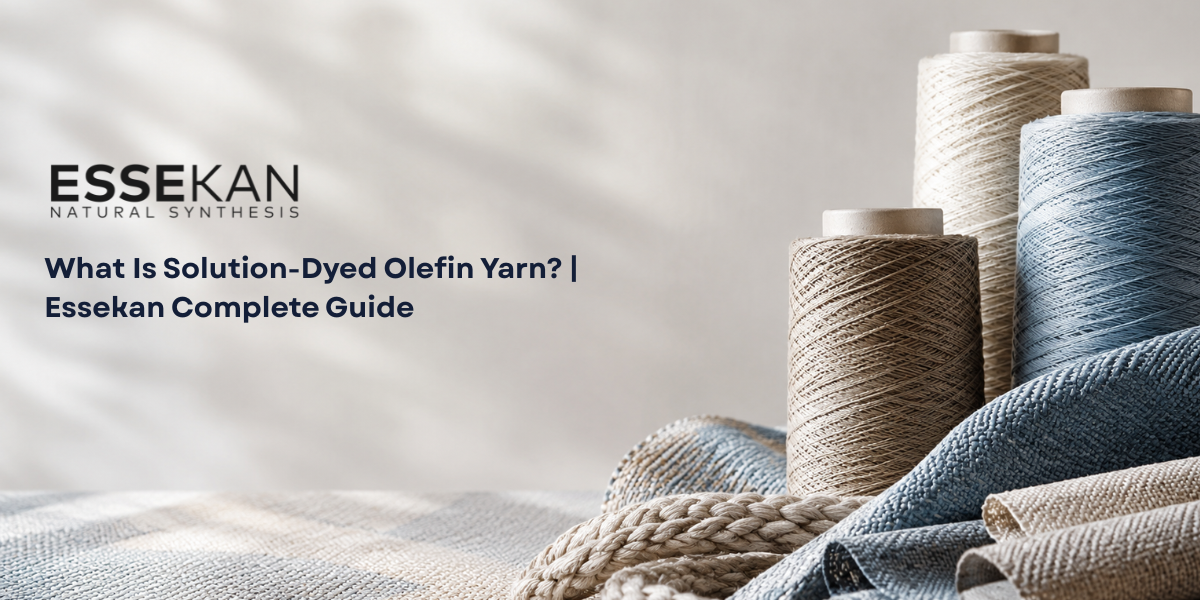
Outdoor and performance fabrics are expected to do much more today than simply look attractive. Whether used in patio furniture, marine upholstery, hotel furnishings, or interior applications, fabrics need to endure constant exposure to sunlight, moisture, friction, and usage without failing.
The textile manufacturing industry faces a major challenge. How can fabrics be manufactured to ensure long-term durability and consistency? The solution comes from the yarn level.
The solution-dyed olefin fibre has developed into one of the best-known performance textile fibres based on colourfastness and UV stability from a single yarn system. Solution-dyed olefin yarns, including Taslan and Super Taslan constructions, have been designed specifically for outdoor, marine and contract textile uses. In contrast to typical dye processes that involve adding colour after manufacturing the fabric, solution dyeing is performed by infusing pigments into the polymer before extrusion.
Textile manufacturers across India and Southeast Asia are continuing to expand outdoor, marine, and contract textile production. Solution-dyed olefin yarn is becoming increasingly significant in high-performance textile manufacturing.
What Is Olefin?
Polypropylene (and, on rare occasions, polyethylene) fibers are known in the textile industry as olefin. The term “olefin” has been derived from the wider family of polymers called “polyolefins,” but within the scope of yarn and textile production, when referring to olefin yarns, it means polypropylene (PP).
Polypropylene is a plastic polymer made from propylene molecules. Polypropylene pellets are loaded into an extruder where they are melted and extruded through a spinneret, which is a machine having small holes through which molten polymer is extruded as filaments.
This process produces a fibre with several important natural properties:
- It is the lightest major synthetic fibre, with a specific gravity of 0.91, lighter than water. Most synthetic fibres have a specific gravity closer to 1.38.
- It has no active dye sites in its molecular structure, which means it cannot absorb conventional dyes the way polyester or nylon can.
- It is inherently hydrophobic; it resists moisture absorption.
- It has good chemical resistance, tolerating most acids, alkalis, and salts without degradation.
What Does "Solution-Dyed" Actually Mean?
To understand solution dyeing, it is important to first understand how conventional textile dyeing works and why it falls short for certain applications.
Conventional Dyeing: Colour Applied After Fibre Formation
In conventional dyeing methods (either yarn, package, or piece dyeing), the fibre or fabric is formed first, and subsequently, coloration takes place in a separate process. The fibre or fabric undergoes immersion in a dyebath, where the dye molecules diffuse into the fibres and adhere to them.
This produces fibres that are coloured mainly on the surface. It is similar to applying paint to a surface; the paint just stays on the surface or possibly even a few molecules thick into the material. Over time, these molecular bonds weaken as they are exposed to the effects of light, heat, chlorine, salt, or even water.
Water consumption is another major issue. In conventional dyeing, this process is among the most water-consuming stages in the production of textiles, because large amounts of water are required for both dyeing and repeated rinsing stages.
Solution-Dyeing: Colour Built Into the Fibre Itself
Solution dyeing, also referred to as dope-dyeing or mass coloring, employs a completely new technique. Colour is not added after fibre production. The coloration occurs before any fiber is formed, as the colorants are mixed with the polymer melt.
Here is what the process looks like:
- Polypropylene pellets are fed into an extruder and melted.
- Before extrusion through the spinneret, a precisely measured masterbatch — a concentrated dispersion of pigment in a compatible carrier resin — is mixed directly into the molten polymer.
- The pigmented melt is then extruded through the spinneret to form filaments.
- As the filaments cool and solidify, the pigment is locked throughout the entire cross-section of each fibre.
The resulting yarn is coloured from the core outward. No surface colour layer can wear away. The pigment is not bonded to the polymer; it is physically embedded within it.
Why Olefin Must Be Solution-Dyed
For synthetic fibres such as polyester, nylon, and acrylic, solution dyeing is optional. For polypropylene, however, it is essential.
As mentioned earlier, polypropylene fibers do not have dyeable functional groups in their polymer chains. This means that they are chemically resistant to the methods and reactions used by conventional dyes. As a result, conventional dyeing methods are ineffective on polypropylene fibres.
This means solution dyeing is not simply an option for polypropylene yarns; it is the only way to achieve a colored yarn. All solution-dyed olefin yarns have been necessarily pigmented in their molten state.
The Core Properties of Solution-Dyed Olefin Yarn
The combination of polypropylene’s intrinsic characteristics and the solution-dyeing process produces a yarn profile that is difficult to match with any other single material. Here are the six properties that matter most to fabric weavers.
1. Outstanding Colour Fastness to UV Light
This is a significant benefit for a weaver of outdoor furniture, sun umbrellas, or marine fabric customers, especially for export to the Middle East, Europe, or Australia, which requires strong sunlight as an indispensable specification.
2. Superior Resistance to Moisture, Salt, and Chlorine
Polypropylene is not absorbent. The moisture gain is almost nil, less than 0.1%. There are two major advantages resulting from this characteristic. Firstly, the yarn will not swell, weaken, or deteriorate in contact with rain, saltwater, or even swimming pool water. Secondly, the yarn dries quickly, thus reducing the risk of mold.
This is in combination with the pigment that has been incorporated, which cannot be bleached due to moisture. This has made solution-dyed olefin yarn the preferred option for use in any textile application, such as pool sides, boats, seating, and any other use in humid environments.
Resistance to chlorine is especially notable in the hotel and pool industries. Most colored materials will show signs of deterioration from chlorine after multiple exposures. The color in solution-dyed polypropylene material does not change under chlorinated water conditions, where other dyed products fade quickly.
3. Low Specific Weight
Polypropylene’s specific gravity of 0.91 makes it the only common commercial textile fibre that floats on water. In practical weaving terms, this means:
- Reduced weight per square metre of fabric for equivalent coverage, valuable when designing lightweight yet high-coverage fabrics intended for use in things such as shade sails and contract seating.
- This type of yarn and fabric lends itself well to marine purposes because it floats naturally without becoming waterlogged.
- Value for money: when fabric is priced by the gram or kilogram, you get more metres per gram or kilogram than other yarns and fabrics.
4. Dye Lot Consistency
One constant problem in traditional dyeing is the batch-to-batch inconsistency that results from the slightest variance in dyeing solution temperature, pH level, water chemistry, or time period. In contract furniture, marine upholstery, and any situation where matching of panels is required, this inconsistency leads to expensive returns and rework.
This is not an issue with solution-dyed yarn. The color is decided by the formula of the masterbatch, and this can always be reproduced precisely. Each batch produced will be identical to the previous one in terms of its color, with the color remaining consistent along the entire length of the yarn.
5. Environmental Credentials
The use of water and chemicals associated with traditional dyeing methods has now turned into a business liability for fabric mills owing to the global brands’ pressure on them. Solution dyeing involves using only about 20 percent of the water needed for traditional dyeing. Similarly, there is minimal use of chemicals as well; there is no need for effluent treatment, fixing agents, or rinsing water.
Solution-dyed Olefin yarn, when chosen by fabric weavers who need to comply with sustainable sourcing practices demanded by buyers from Europe or America, be it GRS, Higg Index, or OEKO-TEX, provides clear evidence of improvement without compromising on the product’s quality.
6. Good Stain and Soil Resistance
The fact that polypropylene is hydrophobic causes water stains to form beads rather than being absorbed. However, while oil stains are not as easy to remove, the closed fibre structure makes it difficult for the stain to penetrate the fibres deeply. This is a valuable feature in textile products used in the hospitality and upholstery industry, public transportation seats, and other recreational areas.
Engineered to meet these performance criteria, Essekan’s dyed olefin yarn product lines include Taslan, Super Taslan, and FDY, and all are backed by OEKO-TEX Classification 1 and GRS certification.
How Solution-Dyed Olefin Differs From Solution-Dyed Polyester or Acrylic
Solution-dyed polyester and solution-dyed acrylic are also available in the market, and fabric weavers sometimes face the question of which fibre to use for demanding applications. The key distinctions are:
Weight: Olefin is considerably lighter than polyester (specific gravity 0.91 vs. 1.38). In cases where fabric weight is one of the criteria set out, then olefin is better structurally.
Moisture absorption: While polyester has low moisture gain, that of olefin is lower. For underwater or continuously wet uses, olefin would be a better option.
Sustainability profile: In terms of production, polypropylene is more sustainable than polyester because its carbon footprint is smaller. This has been consistent from life cycle assessments, which have always shown that it scores low on carbon emissions among synthetics.
Heat sensitivity: The melting point of polypropylene is lower than that of polyester (165°C compared to 260°C). This has implications during finishing. Some of the heat settings used on polyester cannot be used on olefin, as the fabric will be deformed.
Cost: Polypropylene is generally cost-competitive with polyester and more economical than solution-dyed nylon for comparable performance specifications.
What This Means for Fabric Weavers in India and Southeast Asia
The outdoor textiles, marine textiles, and contract textiles segments served by India and Southeast Asia, especially those customers based in Europe, the Middle East, and East Asia, are trending towards stricter performance criteria and sustainability criteria concurrently. Customers require color fastness test reports. ESG compliance officers are verifying tier-2 and tier-3 supply chains.
In such an atmosphere, the yarn choice becomes more than simply a cost consideration. The yarn represents the juncture in the value chain at which performance and sustainability can be most effectively managed.
With solution-dyed olefin yarn, the weaver can provide a fabric that does not fade, does not mildew, does not show variation from lot to lot, and has an honest environmental story from the very beginning, without even considering anything about sustainability at the mill.
Conclusion
Solution-dyed olefin yarn has proved to be one of the most consistent yarn systems used in the manufacture of today’s performance textiles. This is because of its ability to resist UV rays, withstand water, provide durability and performance through lightweight, and also have color fastness.
The uniqueness of this process lies in the fact that it offers both sustainability and performance. The reason is that since the pigment is embedded inside the polymer by way of extrusion, less water is used, as well as less waste.
With the increasing demand from customers for products that are more durable and sustainable as textile producers in India and Southeast Asia keep producing their goods for international markets, it is clear that solution-dyed olefin yarn is here to stay and will play a pivotal role in the future of textiles.
For application-specific guidance on yarn construction, weave compatibility, and sampling, submit a B2B enquiry or download the product data sheets to review specifications.
Frequently Asked Questions
What is solution-dyed olefin yarn?
Solution-dyed olefin yarn is a polypropylene-based synthetic yarn where pigment is added directly into the polymer before fibre extrusion. This creates long-lasting colour, strong UV resistance, moisture protection, and excellent durability for demanding textile applications.
Why is solution-dyed olefin yarn used in outdoor textiles?
Outdoor textiles require resistance against sunlight, moisture, fading, and harsh weather conditions. Solution-dyed olefin yarn performs exceptionally well outdoors because its colour is embedded throughout the fibre, helping fabrics maintain appearance and performance for significantly longer periods.
How is solution dyeing different from conventional dyeing?
In conventional dyeing, colour is applied after the yarn or fabric is produced. Solution dyeing integrates pigment into the polymer before extrusion, creating better colour fastness, lower water consumption, improved UV stability, and greater long-term durability.
Is olefin yarn suitable for marine applications?
Yes. Olefin yarn is highly suitable for marine textiles because it resists moisture absorption, mildew growth, saltwater exposure, and UV degradation. These properties make it ideal for marine upholstery, seating fabrics, protective covers, and performance marine interiors.
What are the main advantages of solution-dyed olefin yarn?
Solution-dyed olefin yarn offers strong UV resistance, fade resistance, moisture protection, lightweight performance, chemical resistance, fast drying behavior, and long-term durability. It also supports more sustainable textile manufacturing through reduced water and chemical consumption during production.
Is solution-dyed olefin yarn environmentally friendly?
Solution dyeing significantly reduces water usage, wastewater generation, and chemical processing compared to conventional dyeing methods. Combined with olefin’s durability and long product lifespan, this makes solution-dyed olefin yarn a more environmentally responsible textile solution.
Why do textile manufacturers prefer solution-dyed olefin yarn?
What industries commonly use solution-dyed olefin yarn?
Solution-dyed olefin yarn is widely used in outdoor furniture, marine upholstery, hospitality fabrics, contract textiles, automotive interiors, floor coverings, performance upholstery, and technical textile applications requiring durability and long-term weather resistance.
Is solution-dyed olefin yarn resistant to fading?
Yes. Because pigment is integrated throughout the entire fiber structure during manufacturing, solution-dyed olefin yarn offers exceptional fade resistance even after prolonged exposure to sunlight, moisture, cleaning chemicals, and demanding outdoor environmental conditions.
What makes olefin yarn different from polyester?
Olefin yarn is lighter, more hydrophobic, and dries faster than polyester. It also performs exceptionally well in outdoor and wet environments because of its moisture resistance, mildew resistance, and strong UV stability in long-term performance applications.