Taslan Air-Textured Yarn: The Technical Guide for Textile Engineers
Outdoor and performance textiles need to balance UV resistance, durability, moisture management, shape retention, and comfort. While flat filament yarns provide strength and uniformity, they often lack the soft, spun-like feel required for many applications.
Taslan air-textured yarn (ATY) combines the strength of continuous filaments with a softer, more natural appearance. Essekan’s solution-dyed polypropylene Taslan yarn offers UV resistance, colour fastness, moisture resistance, and durability, making it suitable for outdoor furniture, performance fabrics, filtration media, and industrial textiles.
Essekan also manufactures Super Taslan for greater softness and bulk, and FDY for high strength and dimensional stability, providing a versatile polypropylene yarn portfolio for outdoor and technical applications.
What Is Taslan Air-Textured Yarn?
Taslan was originally a brand name registered by E.I. du Pont de Nemours and later became a widely used term for air-textured yarns made using compressed-air technology.
Essekan’s Taslan yarn uses solution-dyed polypropylene filaments that are air textured to create a soft, matte, linen-like appearance while retaining the strength and durability of continuous filament yarns. Built-in UV stabilisers and solution-dyed colour technology provide strong weather resistance, colour fastness, and durability for outdoor upholstery, technical textiles, and performance fabrics.
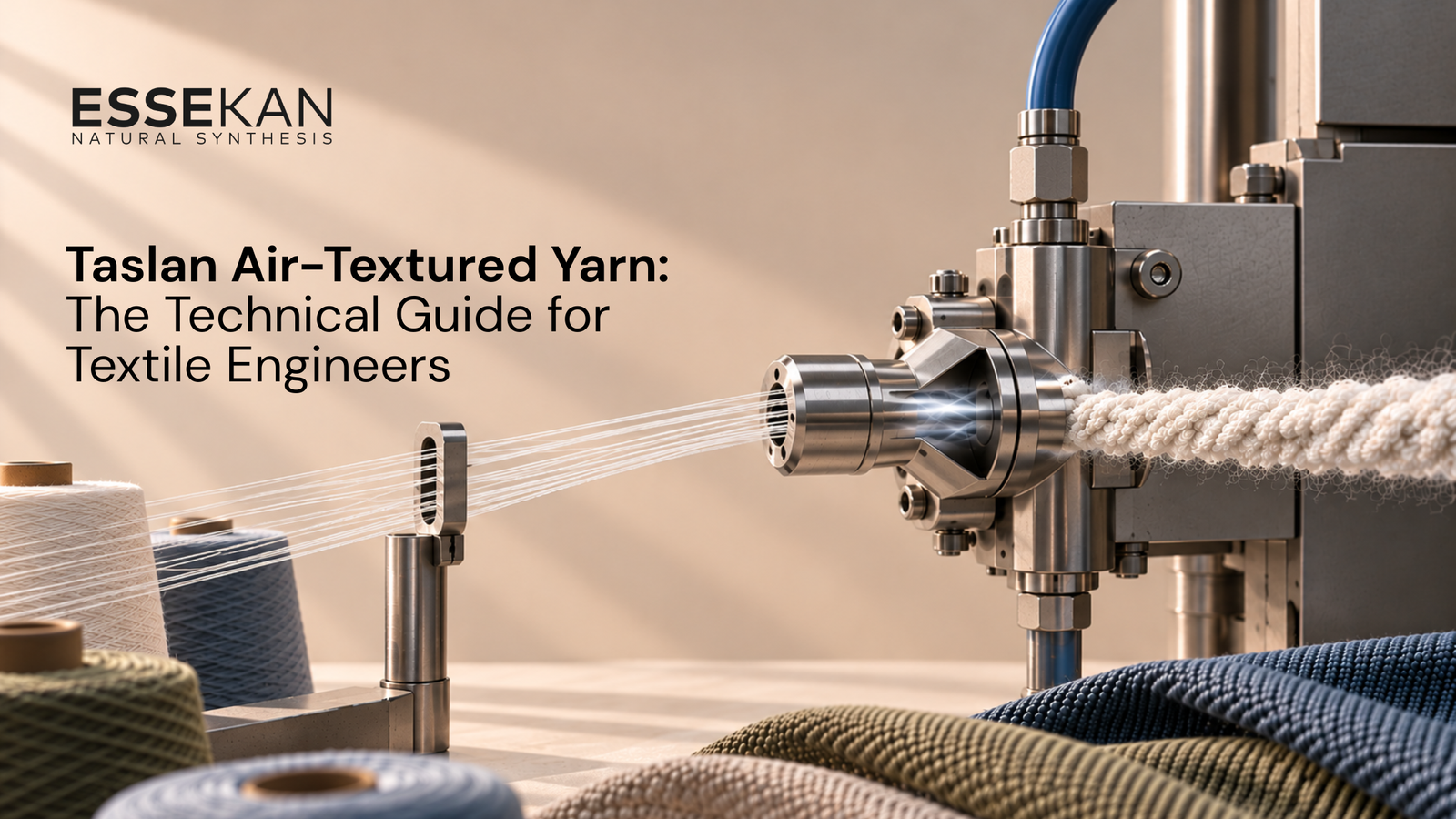
During air-jet texturing, continuous multifilament yarn passes through a high-pressure air nozzle. Turbulent airflow separates, bends, and entangles the filaments, creating a stable three-dimensional looped structure that gives Taslan its distinctive texture and feel.
The final yarn develops characteristics that are significantly different from flat filament yarns:
- Softer hand feel
- Improved fabric cover
- Matte appearance
- Improved moisture management
- Soft hand feel and natural spun-like aesthetics
- More natural, spun-like aesthetics
A key advantage of air texturing is that it creates texture through mechanical filament entanglement rather than thermal crimping. This allows continuous filament yarns to be textured without heat-setting, making the process suitable for a wider range of filament materials than conventional false-twist texturing.
The Engineering Principle Behind Air Texturing
The core principle behind Taslan ATY is fluid-induced filament entanglement through turbulent airflow. In the air-jet nozzle, turbulent flow is produced due to compressed air. Overfeeding introduces excess filament length into the jet chamber, reducing axial filament tension.
As the turbulent airflow destabilises the yarn bundle, several things happen simultaneously:
- Filaments buckle
- Filaments separate from the bundle
- Random loops begin forming
- Inter-filament entanglement develops
These microscopic loops create the bulk and texture associated with ATY.
The resulting ATY fibre has many stabilized loops along its length. Such loops help to increase the surface area, cover factor, and capillarity of the fibre.
The quality of the final yarn and overall Taslan yarn technical specifications depend heavily on controlling several engineering variables:
- Air pressure
- Overfeed ratio
- Yarn tension
- Water application
- Nozzle geometry
- Take-up speed
Even small process changes can significantly affect yarn bulk, cohesion, and regularity.
Taslan ATY vs False-Twist DTY
Air Textured Yarn (ATY) and Draw Textured Yarn (DTY) are two common methods for texturing continuous filament yarns, but they use different processes and produce distinct performance characteristics.
DTY uses a thermo-mechanical false-twist process involving heating, twisting, and cooling to create crimp. Taslan ATY uses compressed-air turbulence to create mechanical loops and entanglement without heat.
As a result, ATY typically offers a softer, fuller, spun-like appearance with lower stretch, while DTY provides a smoother appearance and greater elasticity. ATY can also accommodate a broader range of fibre types and generally operates without high-temperature heaters, reducing energy requirements and thermal stress on the yarn.
These differences make ATY and DTY suitable for different textile applications and performance requirements.
Why Water Matters in ATY Processing
Although ATY is not a thermal process, controlled water addition can influence yarn quality and process stability. Typically added before the air-jet nozzle at around 0.5 – 3.0%, water helps reduce filament friction and improves filament mobility during loop formation.
It can also reduce bending stiffness in certain fibres, supporting easier filament buckling and texturing. As the yarn exits the nozzle, the thin water film can temporarily help stabilize newly formed loops through surface tension.
Without sufficient water application, several problems can occur:
- Lower yarn bulk
- Higher irregularity
- Reduced cohesion
- Poor loop stability
Commercial ATY lines often face quality issues due to inconsistent wetting systems, blocked nozzles, or unstable water application rates.
Processing Behaviour by Fibre Type
Solution-dyed polypropylene is preferred for Essekan’s Taslan yarn for its UV resistance, moisture resistance, durability, and reliable outdoor performance. It is well suited to outdoor furniture, technical textiles, and performance fabrics.
Polyester (PET)
Polyester can also be air textured for apparel, automotive textiles, and industrial fabrics. However, for demanding outdoor applications, Essekan focuses on solution-dyed polypropylene because of its excellent UV resistance, low moisture absorption, and long-term weather performance.
Nylon 6 and Nylon 6.6
Nylon can also be processed using ATY technology for sportswear and performance textiles. However, Essekan’s solution-dyed polypropylene remains the preferred choice for outdoor furniture and technical textile applications.
Polypropylene (PP)
Solution-dyed polypropylene gives Essekan’s Taslan yarn low moisture absorption, UV resistance, colour fastness, and reliable long-term outdoor durability. It helps fabrics dry quickly while resisting mildew and weather-related damage.
Polypropylene ATY is commonly used in:
- Outdoor upholstery
- Garden and patio furniture
- Marine textiles
- Geotextiles
- Filtration media
- Technical fabrics
Although polypropylene typically requires slightly higher overfeed ratios during air texturing to achieve optimum loop formation, it produces durable yarns with excellent dimensional stability, abrasion resistance, and weather performance.
Viscose and Lyocell
Cellulosic fibres can also be air textured for soft apparel and home textile applications, although these are outside Essekan’s primary polypropylene product range.
Viscose and Lyocell ATY are commonly used in premium apparel and luxury home textiles.
High-Modulus Fibres
Speciality fibres such as aramid and carbon can also be air textured for niche technical applications, although these represent specialised uses beyond Essekan’s core polypropylene yarn portfolio.
Glass Filaments
Glass filaments require specialised processing equipment because of their stiffness and abrasive nature. Air-textured glass yarns are commonly used in fire barriers, acoustic insulation, EMI shielding, and industrial composite materials.
Advantages of Taslan Air-Textured Yarn
Taslan Air-Textured Yarn (ATY), for its unique blend of appearance, durability, and performance, has few parallels among yarn technologies. These qualities make ATY widely applicable across fields such as outdoor apparel, sportswear, upholstery, car covers, and technical textiles.
Spun-Like Appearance with Filament Strength
Taslan ATY combines the soft, natural appearance of spun yarn with the strength and durability of continuous filament yarn. Its air-textured structure creates a matte appearance, linen-like texture, and natural hand feel while maintaining excellent tensile strength and abrasion resistance.
Improved Fabric Cover
The air-textured structure improves fabric cover while maintaining a soft, matte, linen-like appearance without significantly increasing fabric weight. This enhances opacity, dimensional stability, and comfort, making Taslan suitable for outdoor upholstery, apparel, and technical textile applications.
Soft Touch and Comfort
Air-textured filament yarn offers a soft touch and more natural feel than flat filament yarns, improving wearer comfort and fabric aesthetics across a wide range of end uses.
For applications requiring greater bulk and a softer, wool-like texture, manufacturers often choose Super Taslan yarn, while standard Taslan provides a cleaner, matte, linen-like appearance.
Improved Moisture Management
The air-textured structure creates microscopic capillary channels that improve moisture transport and wicking performance, making Taslan suitable for outdoor apparel, performance fabrics, and technical textiles.
Lower Pilling Tendency
Because Taslan ATY is manufactured from continuous filaments rather than staple fibres, it exhibits lower pilling and maintains a cleaner surface appearance over extended use.
Excellent Abrasion Resistance
Taslan retains the strength of continuous filament yarn while offering enhanced surface texture, providing excellent abrasion resistance for demanding applications such as outdoor furniture, upholstery, automotive textiles, and industrial fabrics.
Major Application Areas
Outdoor Apparel
Taslan ATY combines comfort, durability, and a natural, matte appearance, making it well suited to jackets, hiking trousers, and sportswear. Its excellent abrasion resistance, soft hand feel, and moisture management properties provide lasting performance and comfort in demanding outdoor environments.
Upholstery and Home Textiles
The high bulk properties of ATY yarn result in fabrics with outstanding coverage, dimensional stability, and durability. With their softness and dull finish, these yarns are widely used for upholstery fabrics, curtains, cushions, and outdoor furniture where abrasion resistance and sunlight exposure are important considerations.
Manufacturers often combine Taslan, Super Taslan, and FDY yarns to achieve different performance characteristics. Taslan provides a matte, linen-like finish, Super Taslan offers greater bulk and softness, while FDY delivers high strength and dimensional stability for woven fabrics.
Automotive Textiles
Taslan ATY is used in automotive applications such as seat covers, headliners, carpet backing, and acoustic materials. It provides durability, softness, and dimensional stability while enhancing passenger comfort. Its abrasion resistance and ability to retain appearance over time make it particularly suitable for automotive interiors.
Sportswear and Performance Fabrics
ATY is commonly used in athletic clothing due to its structure, which enhances moisture management and wearer comfort. Fabrics made from air-textured yarn are lightweight, breathable, and comfortable, making them ideal for sportswear and performance apparel.
Technical and Protective Textiles
High-performance ATY systems are used in fire-resistant garments, abrasion-resistant gloves, composite reinforcements, and industrial safety textiles. The air-texturing process improves the processability of aramid and carbon fibres while preserving their inherent strength and performance characteristics.
Filtration and Geotextiles
ATY polypropylene yarn is widely used in filtration media and geotextiles because its bulkier structure increases surface area and supports efficient fluid flow. These yarns are suitable for drainage systems, filtration applications, and reinforcement materials that require durability, lightweight performance, and chemical resistance.
Common Processing Challenges
Poor Cohesion
Excessive overfeed, unstable air pressure, or inadequate wetting can weaken filament entanglement, causing yarn instability during weaving, knitting, and winding.
High Yarn Irregularity
Inconsistent water application, tension, or nozzle conditions can affect loop formation, resulting in uneven yarn bulk and appearance.
Low Bulk Development
Low overfeed, insufficient nozzle turbulence, or incorrect air pressure can reduce filament looping and produce inadequate yarn bulk.
Excessive Filament Breakage
High yarn tension, rough machine surfaces, or intense processing conditions can cause filament breakage, particularly with high-modulus fibres. Proper tension and process control help minimize damage.
Final Thoughts
Taslan air-textured yarn continues to be one of the most versatile yarn technologies for modern textile manufacturing. By combining the strength of continuous filament yarns with a soft, matte, linen-like appearance, it delivers the durability, comfort, and performance required for outdoor, industrial, and technical textile applications.
Essekan’s solution-dyed polypropylene Taslan, Super Taslan, and FDY yarns are engineered to provide excellent UV resistance, colour fastness, moisture resistance, and long-term durability. As demand for high-performance and sustainable textiles continues to grow, these yarns remain a reliable choice for manufacturers seeking consistent quality and lasting performance.
Frequently Asked Questions
What is Taslan air-textured yarn?
What is the difference between ATY and DTY?
ATY uses aerodynamic turbulence to create texture mechanically, while DTY uses heat-set crimping through false-twist processing. ATY produces softer and more matte yarns, while DTY produces stretchier yarns.
Can recycled polypropylene be used in Taslan yarn?
Which fibres can be air textured?
Why is water used in ATY processing?
Is Taslan yarn suitable for outdoor fabrics?
Does ATY use less energy than DTY?
Generally, yes. ATY eliminates heater systems, making it more energy-efficient than false-twist DTY processes.