
Solution-Dyed Olefin Fabric Benefits | Performance, Care & Durability
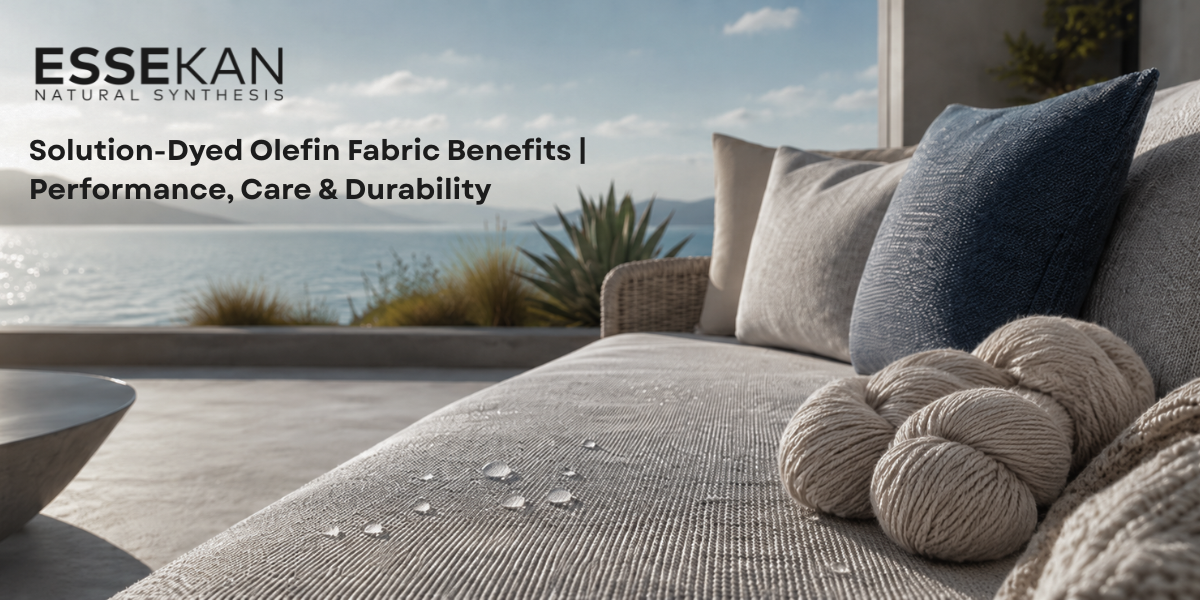
Most outdoor fabrics look good in a showroom.
The real distinction emerges six months down the line, when one cushion shows signs of uneven fading from exposure to sunlight, while another reeks of moisture due to the monsoon weather.
It is for this reason that the importance of solution-dyed olefin material has gained more ground as a component for upholstery in exterior, marine, and commercial applications. Customers do not choose the fabric solely based on its visual appeal but by its performance under the constant abuse of sun, chemicals, moisture, spillage, and commercial use.
Solution-dyed olefin is different in that it isn’t simply marketing language and surface coating. It’s an actual physical characteristic created in the fibre. This gives the yarn a colour during the manufacturing process that results in a change in its reaction to light, moisture, chemicals, and friction.
The importance of this is that most failures of outdoor fabrics are not due to tearing. Instead, they are due to discoloration, staining, mold growth, non-uniform aging of colours, and maintenance difficulties.
The Performance Problem Most Outdoor Fabrics Face
Outdoor upholstery fails gradually.
The process typically starts with a loss of color consistency. Those parts that receive direct sunlight tend to lose their color much more quickly compared to those that do not receive any light at all. Chlorine exposure results in a chemical whitening of the furniture located near the pool. The cushions tend to hold water after rain.
Many traditional fabrics use either topical dyeing processes or treatments to avoid these problems. The problem with such coatings and dyes is that they deteriorate because they stay in contact with the environment.
Solution-dyed olefin approaches the problem differently.
Instead of adding colour after fibre production, pigments are introduced directly into the polymer melt before extrusion. The fibre itself becomes coloured throughout its entire cross-section rather than only on the outer surface.
That single manufacturing change is what creates most of the fabric’s long-term performance advantages.
Why UV Resistance Is the Biggest Advantage
Upholstery materials are always subjected to UV rays, and hence UV damage is a key factor that causes premature aging of fabric materials.
In the case of piece-dyed and surface-dyed fabrics, light acts on dye molecules that are bonded to the fiber’s exterior surface. In such cases, color consistency is lost, and fading occurs slowly. Such effects are more evident when furniture is exposed to uneven lighting.
Solution-dyed olefin performs differently because the pigment exists throughout the fibre structure itself. Even when the outer surface experiences wear, the underlying colour remains consistent.
This is why solution-dyed olefin is widely used in applications where appearance retention matters over long outdoor exposure periods, including:
- Luxury outdoor furniture
- Marine seating systems
- Resort loungers
- Rooftop hospitality seating
- Poolside upholstery
- Outdoor contract interiors
For buyers, this translates into fewer replacement cycles and less visible ageing across installations.
Essekan has designed solution-dyed olefin fabrics to withstand exposure to varying amounts of sunlight over time, so they can maintain their vibrant colours throughout the life of the product in outdoor, marine, and hospitality settings.
The Real Reason Olefin Resists Stains So Well
Stain-resistant properties can be created for other types of fabrics through a process that involves treating them after weaving with chemicals. These chemical finishes may eventually wear off with frequent cleaning or outdoor exposure.
On the other hand, olefin does not have to rely on a post-weaving process. Its hydrophobic nature means that the material hardly absorbs water, leaving most substances on its surface.
In practical terms, this changes how common outdoor contaminants behave.
The removal of coffee, wine, leftover sunscreen, chlorinated water, and food stains is usually easier since they do not bind themselves so strongly to the fiber material.
It is particularly crucial in hospitality settings where the upholstery is exposed to contamination on a daily basis. When the fiber itself repels stains, it works more effectively and reliably than those that only resist stains temporarily through an external protective coating.
The Real Reason Olefin Resists Stains So Well
Most buyers associate moisture resistance only with quick drying, but the bigger impact is actually long-term hygiene and durability.
Water-absorbent materials create the perfect environment for mould, bacteria, odour production, and foam degradation. In such environments, especially when dealing with beach furniture, this can be one of the toughest maintenance issues.
The hydrophobic properties of solution-dyed olefin make it one of the most waterproof upholstery textiles due to its ability to absorb water vapor at a rate of less than 0.1%.
The absence of moisture in the fiber structure makes the material dry more quickly when it comes into contact with rainwater or humidity. The major advantage is that it prevents the development of fungus, which causes an odor.
This is one of the reasons solution-dyed olefin performs particularly well in:
- Coastal hospitality projects
- Marine upholstery
- Poolside seating
- Tropical climates
- Semi-outdoor commercial environments
The performance advantage is not simply comfort after rainfall. It is long-term resistance to biological deterioration.
Why Bleach Cleanability Matters in Commercial Upholstery
One of the most overlooked benefits of solution-dyed olefin is its tolerance for bleach cleaning.
Commercial spaces are subject to stringent cleansing protocols. In hospitality, health care settings, maritime upholstery, and public spaces, upholstery needs sterilization rather than simple stain removal.
A lot of fabrics fade when placed in oxidizing agents due to the fact that the dye resides in the fiber. Olefin solution-dyeing stands out because the dye is actually part of the fiber.
This allows the fabric to tolerate diluted bleach cleaning solutions far better than many conventional upholstery materials.
This is an important operational advantage for contract buyers. If a fabric can be subjected to several sterilizations and not lose its colour fast, then the furniture installation will be durable enough.
Abrasion Resistance Matters More Indoors Than Outdoors
Even though the use of solution-dyed olefin is generally linked to outdoor furniture, most of the benefits of this material manifest indoors in commercial environments.
Commercial seating endures wear and tear due to constant use. The material wears down, pills, frays, or becomes worn at high-contact points.
Unlike other ornamental fabrics, where beauty is considered before everything else, olefin fabric is produced mainly considering its ability to withstand mechanical stress.
Where Solution-Dyed Olefin Performs Better Than Acrylic
Solution-dyed acrylic is marketed as the top choice for outdoor fabrics due to its soft touch and rich drape. Solution-dyed olefin fabric usually outshines solution-dyed acrylic when hygiene considerations outweigh the value placed on the softness factor.
Olefin generally offers:
- Lower moisture absorption
- Better bleach tolerance
- Stronger stain resistance
- Faster drying performance
- Lower overall maintenance requirements
In applications such as marine upholstery, hospitality seating, and outdoor furnishings, tangible advantages can sometimes outweigh the softness of acrylic, especially for yarn for soft furnishings used in hospitality interiors.
Why Outdoor Furniture Buyers Are Moving Toward Olefin
Outdoor furniture manufacturing has changed significantly over the last decade.
The expectations for outdoor furniture have increased greatly as consumers expect outdoor seating to perform better aesthetically, yet endure all the environmental hazards associated with the outdoors. There is thus an increasing need for the right kind of fabric due to these expectations.
Instead of relying heavily on aftermarket coatings or protective treatments, the fibre itself delivers:
- UV resistance
- Moisture repellency
- Stain resistance
- Mould resistance
- Chemical tolerance
- Abrasion durability
This fibre-level performance consistency is one of the biggest reasons the material continues expanding across outdoor, marine, and contract upholstery markets.
Sustainability and Long-Term Material Efficiency
Similar to most synthetic performance fabrics, olefin comes from petroleum. But the dyeing method used for it lessens some negative effects on the environment compared to the usual way of coloring fabrics.
Traditional dyeing techniques require considerable amounts of water, chemicals, and energy through the processes of dyeing and washing the fabric. Solution dyeing reduces the number of steps required, as pigment is added to fibers before the textile product is formed.
The durability aspect is equally important.
A fabric that keeps its looks and durability properties for many years outdoors means fewer replacements, hence reduced material usage over time.
Why Buyers Researching Performance Fabrics Choose Solution-Dyed Olefin
What really counts is how they hold up under continued UV light exposure, chlorination, humidity, staining, wear, and general usage. This is where solution-dyed olefin really stands apart from most traditional outdoor fabrics.
Advantages do not depend upon surface treatments or coatings. They are a result of the fibre’s engineering during manufacture.
For those buying fabric intended for outdoor furniture, marine seating, hospitality upholstery, or commercial interiors, solution-dyed olefin represents an advantage that becomes increasingly significant in terms of today’s functional textile materials.
Conclusion
The benefits that come from the solution-dyed olefin fiber are intrinsic qualities that have been embedded within the material itself, as opposed to surface treatments that may be applied to a fabric at some later date. The inherent resistance to ultraviolet light, moisture, stains, and cleaning makes this material ideal for environments such as outdoor, marine, hospitality, and contract uses.
The benefit of solution-dyed olefin from the buyer’s perspective is not only the fabric’s performance during initial installation. Regardless of where this product is placed – whether at the beach, at sea, in a hotel lounge, or out in the open – this textile will retain its appearance, minimize maintenance needs, and last longer than traditional materials.
Explore our OEKO-TEX certified yarn range or send us your project specifications to find the right fit.
Frequently Asked Questions
Why does solution-dyed olefin resist fading better than regular outdoor fabric?
Fade resistance is enhanced in solution-dyed olefin because the colour pigment is directly mixed within the polymer even before the creation of the fibres and not merely applied on top of them post-weaving. The presence of the colour pigment can therefore be observed uniformly through the whole fibre. In traditional outdoor fabrics, prolonged exposure to ultraviolet light will result in the degradation of the surface dye pigments, making the material susceptible to fading. In solution-dyed olefin, ultraviolet rays have to affect the fibre structure before any colour changes occur.
Is solution-dyed olefin suitable for poolside furniture?
Yes. Solution-dyed Olefin is one of the most popular choices for use as poolside furniture fabric due to its combination of desirable qualities. It is resistant to moisture, dries up fast after coming into contact with water, does not fade easily, and can withstand the intense rays of the sun. This material is also good for use in locations where there may be contact with chlorine.
Does solution-dyed olefin resist mildew?
Absolutely. Solution-dyed olefin is inherently resistant to mildew due to the very low amount of moisture absorption by the fiber, when compared with other types of material used for upholstery in furniture. Because water cannot readily seep through the fiber, drying occurs quickly after rainfall, high humidity, and even after washing. The low level of moisture is especially beneficial for preventing the growth of mold and mildew, which need moisture to flourish.
Can solution-dyed olefin be bleach cleaned?
In most cases, yes. There are many benefits of solution-dyed olefin; one of which is that it possesses color within its fibers rather than having a color layer on its surface. This means that it can be exposed to bleach-based solutions for cleaning purposes without suffering severe color fading and fiber deterioration if it is done as per the recommended procedures. This quality makes solution-dyed olefin ideal for use in settings such as hospitality, health care facilities, maritime applications, and public areas where upholstery needs frequent cleaning.
Is solution-dyed olefin good for commercial seating?
Yes. Solution-dyed olefin fabric is very appropriate for use in commercial seating as it has abrasion resistance, stain resistance, water repellency, and ease of cleaning, all in one. Top-quality olefin fabrics are able to score high in terms of commercial abrasion resistance. They are not likely to suffer from wear, pilling, or fraying even after extended use. Olefin’s resistance to spillage, ultraviolet radiation, and cleaning makes it useful in maintaining its appearance in commercial settings where the fabric has to endure tough conditions.
How long does solution-dyed olefin last outdoors?
Under standard conditions of use and with proper maintenance, top-quality solution-dyed olefins are able to retain their colour, strength, and appearance for extended periods of time when exposed to outdoor conditions. While this depends on numerous elements, including weather conditions, exposure to sunlight, frequency of cleaning, and quality of installation, it should be noted that the fabric itself is designed to withstand these stresses better than a lot of other materials typically used outdoors.