
Why Textile Manufacturers Are Switching to Olefin FDY Yarn for High-Performance Fabrics
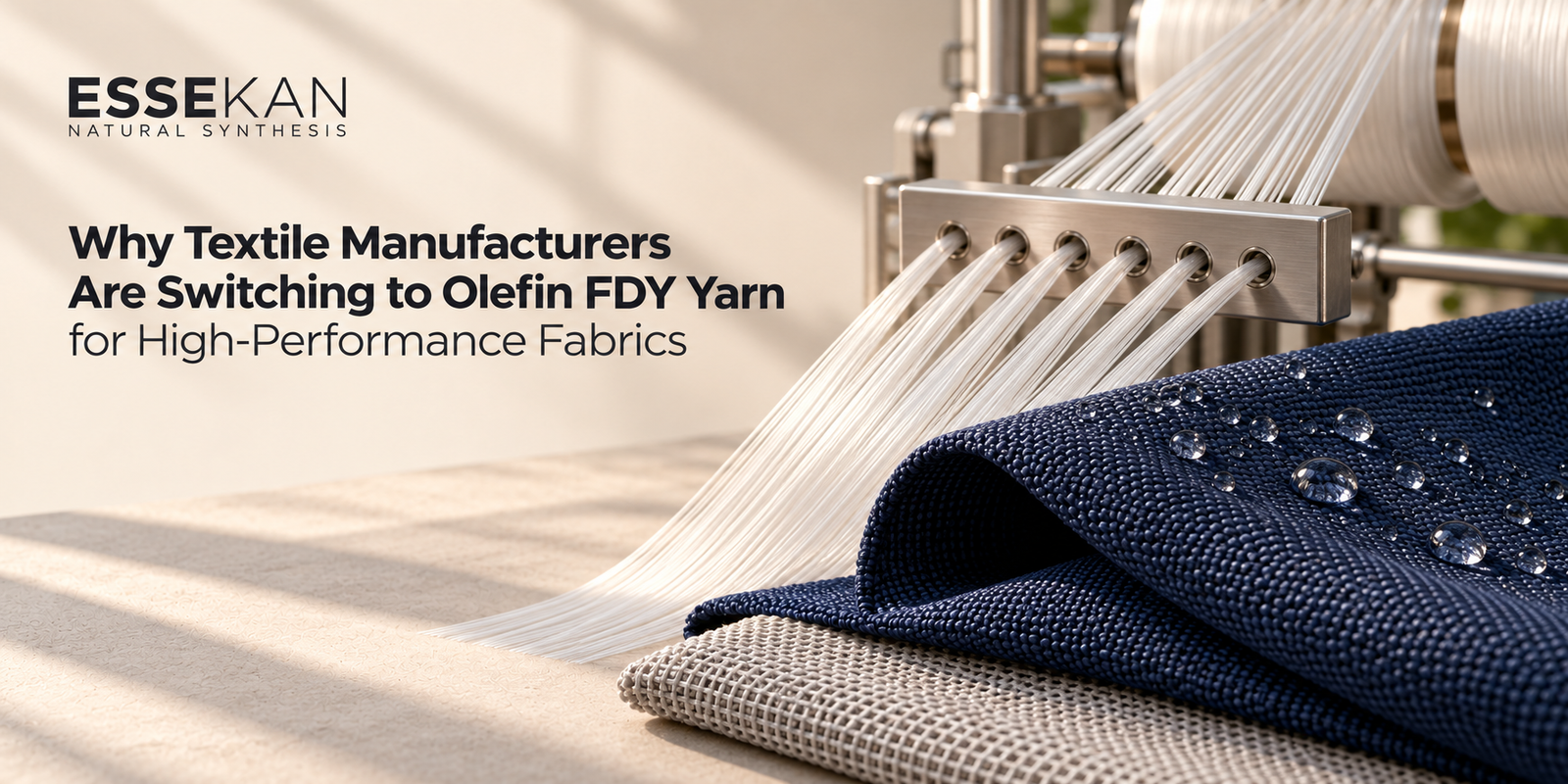
In the Indian textile industry, the way of choosing raw materials has changed. The tendency to switch to FDY yarn has become apparent. The rise in popularity of lightweight, moisture-resistant, and cost-effective performance fabrics, such as sportswear and technical textiles, pushes manufacturers to switch from traditional filament yarns to better alternatives. It also influences the evaluation criteria when choosing FDY yarn manufacturers in India. The quality of the product, its precise denier, and fibre properties became equal in importance to price.
In the following blog post, we will talk about the nature of olefin-based FDY, its manufacturing process, applications, and the features to consider in FDY yarn suppliers.
Olefin-Based FDY vs Standard FDY Polyester Yarn
Olefin (polypropylene-based) filament yarn is hydrophobic, chemically resistant, and exponentially lighter than polyester of the same denier. In contrast to FDY polyester yarn, moisture is not absorbed by olefin fibre. It stays on the surface, which is why the fibre performs perfectly in activewear, geotextiles, and outdoor fabrics. Many mills that have in stock a range of products from a polyester FDY yarn manufacturer also add olefin-based versions to satisfy customers’ need for moisture wicking or reduced fabric weight.
FDY Yarn Manufacturing Process
Knowing the manufacturing process of Olefin FDY Yarn helps to understand the reasons why fully drawn yarn performs better than textured yarns. The FDY yarn manufacturing process involves extruding molten polymer chips through a spinneret, followed by spinning and drawing the filaments in a continuous process. These stages are normally separate in processes such as POY-DTY. The result is a fully oriented and low-shrinkage yarn with tight denier tolerance and good dye uniformity.
When the FDY yarn manufacturing process is applied to olefin polymer, it results in a stronger filament relative to its weight with high dimensional stability due to multiple washings or outdoor wear; that is the reason for the switch by technical fabric producers.
Why Manufacturers Switch to Olefin FDY Yarn
There are three major reasons behind the choice made by manufacturers.
- Cost efficiency and lightness: The cost of producing olefin FDY yarn is less than that of several types of polyester yarn per kilogram, and it provides a larger surface area than its weight
- Government-supported demand: India’s technical textiles sector, a key end-use market for polyester and olefin filament yarns, has been expanding rapidly. The Ministry of Textiles’ baseline survey, cited by NITI Aayog, projected the domestic technical textiles market crossing ₹2 lakh crore, a scale that’s pulling more manufacturers toward performance fibres like olefin.
- Performance demands: Some clothing companies that buy sportswear, filters, and auto interior fabrics need a yarn that is moisture-wicking and resistant to chemicals. These are natural qualities of olefin and not standard polyester.
FDY Yarn Applications Across Various Industries
The wide range of FDY yarn uses extends across several industries, with olefin-based FDY offering additional options for lightweight and moisture-resistant applications:
- Apparel and Activewear: moisture-wicking base layers and performance sportswear
- Home textiles: upholstery backing, carpet facing, and furnishings
- Technical and Industrial textiles: geotextiles, filtration fabric, ropes, and webbing
- Automotive: interior trim and lightweight composite reinforcements
- Packaging and Agriculture: woven sacks, mulch covers, and shade netting
As the list of Olefin FDY Yarn uses continues to extend beyond weaving and knitting, consumers ask for both FDY polyester yarn and olefin FDY yarn in one place rather than separately.
Choosing the Right FDY Yarn Manufacturer in India
Not all polyester FDY yarn manufacturers will be able to provide both fibre types to you at a consistently high quality. To choose the best FDY yarn manufacturer in India, check whether they:
- Have their own quality assurance and denier testing processes
- Possess modern draw spinning lines for handling both polyester and olefin polymer
- Have relevant certifications and export experience
- Provide consistent colouring and dyeability across production runs
That is why cooperation with a known polyester FDY yarn manufacturer that has also invested in olefin production can give buyers an extra benefit: one source for both fibres and fewer supply chain quality variables.
How to Check FDY Yarn Quality Before Placing a Bulk Order
Before committing to a large order, it’s worth running a few basic checks with any shortlisted
supplier:
- Ask for a denier and tenacity test report for the specific batch or lot of FDY polyester yarn you’ll receive, not just a general product specification sheet.
- Request a small trial roll and run it through your own weaving or knitting line before confirming bulk quantities; this catches issues like uneven dye uptake or filament breakage that spec sheets won’t show.
- Check shrinkage and shade consistency across at least two to three production batches, since single-sample testing can hide lot-to-lot variation.
- Confirm packaging and cone specifications match your machine requirements, especially for export orders where cone weight and winding tension affect downstream processing.
- Review the supplier’s export documentation history; consistent HS code classification and prior shipping records reduce customs delays.
Suppliers who are transparent about test data and willing to send trial rolls are generally a safer long-term fit, regardless of whether you’re sourcing standard polyester or olefin-based FDY.
Olefin FDY Yarn and Polyester FDY Yarns from Essekan
Our Olefin FDY Yarns are created for manufacturers requiring lightweight, moisture-resistant filament, while our polyester yarns serve common weaving and knitting uses. Our quality assurance process follows a controlled FDY yarn manufacturing process, with consistent draw ratios, in-line monitoring, and batch-level testing. This helps fabric producers achieve predictable results whether they are sourcing polyester yarn or olefin filament from us.
Explore our full product range or get in touch for technical specification sheets and sample requests.
Related Articles / Also Read